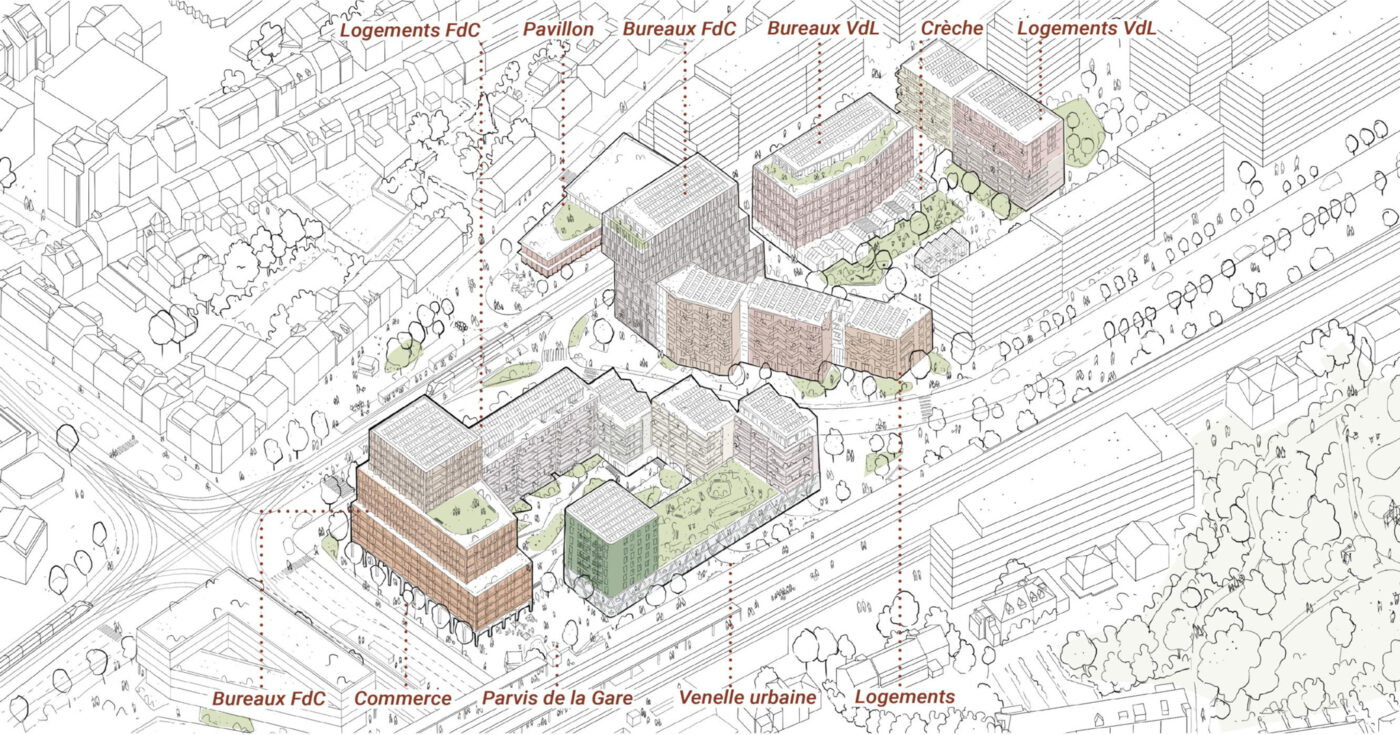
Nei Hollerich Ouest Mixed-Use Urban Development
A two-phase paid consultation was launched in 2023 by the Fonds de Compensation commun au régime général de pension (FdC) and the Ville de Luxembourg (VdL), with the aim of developing a mixed-use urban complex on their plots located in the Nei Hollerich Ouest district.
As part of this process, the portion of the site corresponding to the former CNS, developed directly by the City and the FdC, was the subject of an urban and architectural consultation aimed at selecting several international teams and ensuring a coherent architectural diversity.
Five teams participated in the procedure. At the end of the competition, three winning teams were selected to develop different lots representing a total area of approximately 18,000 m². The architectural duo BFF… and Fabeckarchitectes was named laureate in May 2024 for lots 3.1 and 3.2.
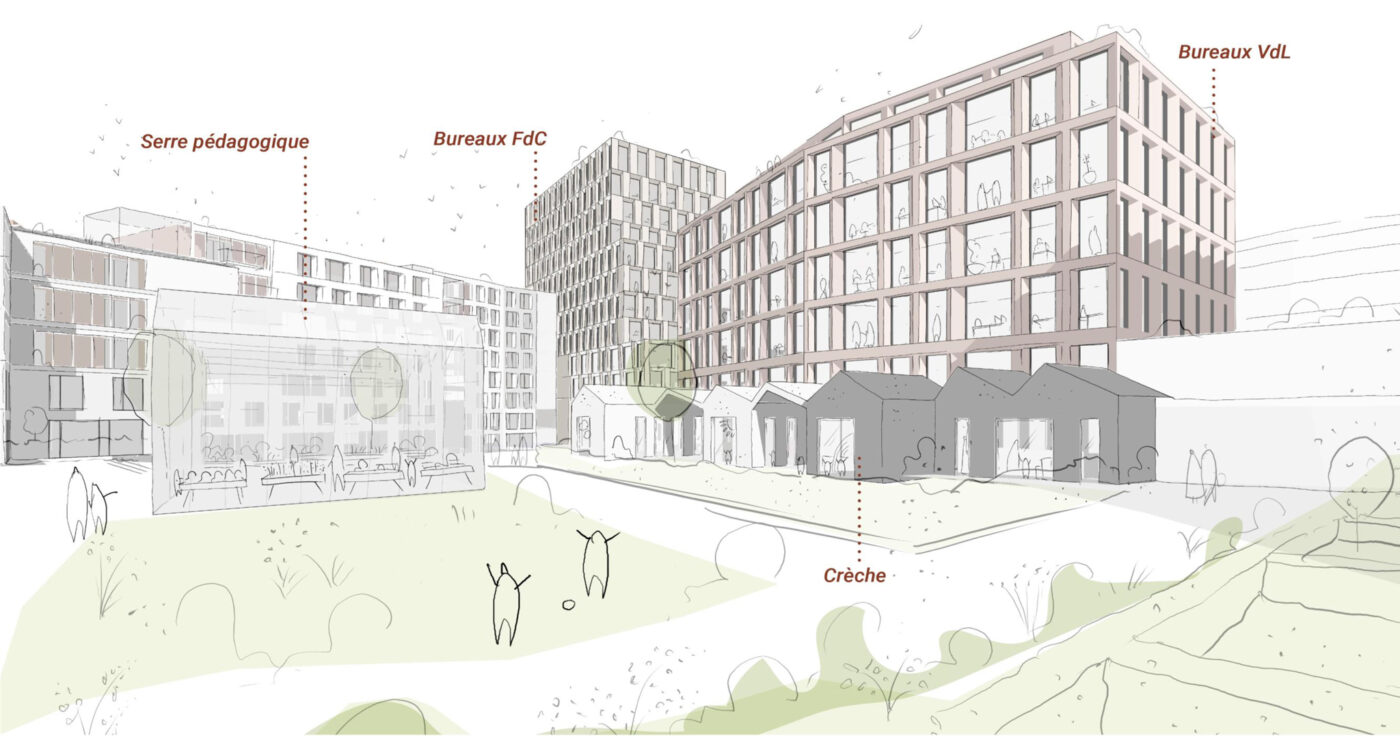
Lot 3.1 covers a floor area of 3,948.87 m² and belongs to the Fonds de Compensation (contracting authority 1), while lot 3.2 extends over 4,654.84 m² and falls under the Ville de Luxembourg (contracting authority 2).
The consultation proposal covers all 4 lots of the PAP NQ “Nei Hollerich” with a total area of approximately 1.8 ha, encompassing the delivery of affordable housing, offices, retail, and community facilities around the future Hollerich interchange hub.
For the next steps and the definitive award of the commission, the architectural duo agreed to split the project in two, with each firm working on the lot on which they had focused most during the consultation, while ensuring ongoing exchanges to maintain overall coherence.
Accordingly, Fabeckarchitectes is working on lot 3.1 for the FdC, and BFF… on lot 3.2 for the VdL.
Architectural, Urban, and Landscape Concept of the Paid Consultation
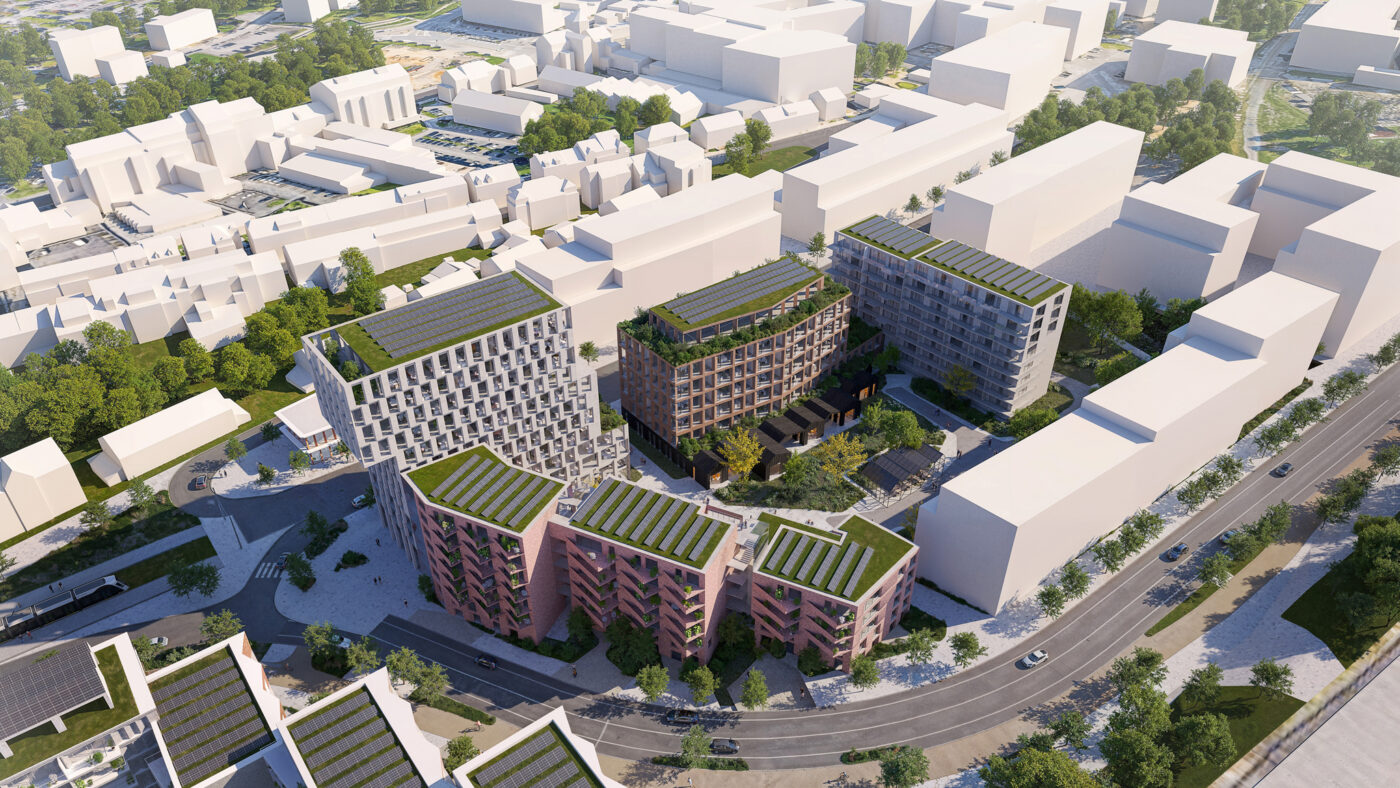
Located at the western end of the Nei Hollerich sector, the FdC and VdL plots are bounded to the north by rue de l’Aciérie, to the south by the railway lines, to the west by the route d’Esch, and to the east by the remainder of the future Nei Hollerich district. The site benefits from enhanced accessibility thanks to the introduction of a new tram line, with a stop positioned at the future public square, as well as the planned Hollerich station interchange hub, set to become a major mobility node. In addition, a bypass boulevard, a cycling path, and a pedestrian walkway running alongside the tram line are all incorporated into the PAP.
The overarching ambition is to transform this space — defined by urban flows — into a vibrant, human-scale, and sustainable neighbourhood, organised around two blocks, each with its own identity and structured around green cores.
The architectural language of the project draws strongly on the site’s industrial past. It reinterprets the codes of the existing architecture through durable materials and a contemporary vocabulary, in order to create an identity that is coherent and rooted in its historical and social context. Two tall buildings mark the entrances to the district and engage with the public realm while maintaining a harmonious scale. The other buildings are positioned to shield the inner courtyards from noise and to maximise sunlight exposure.
The project places strong emphasis on soft mobility and urban connectivity. Public spaces are conceived as pleasant transition areas between the station, the tram, and the residential areas. Pedestrian routes, commercial arcades, and the permeability of the blocks encourage interaction and a sense of community. Ground floors are primarily dedicated to shops, services, and communal facilities in order to animate the neighbourhood throughout the day.
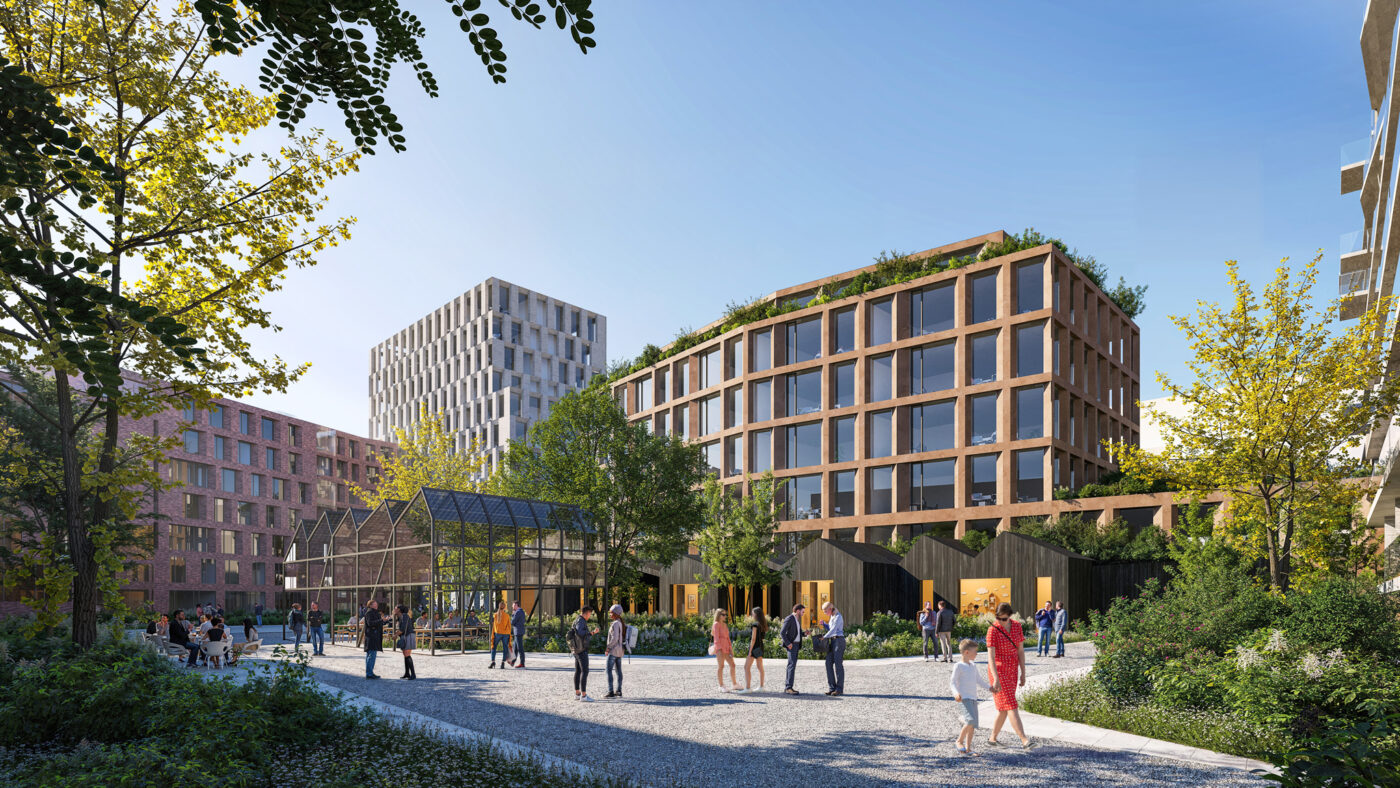
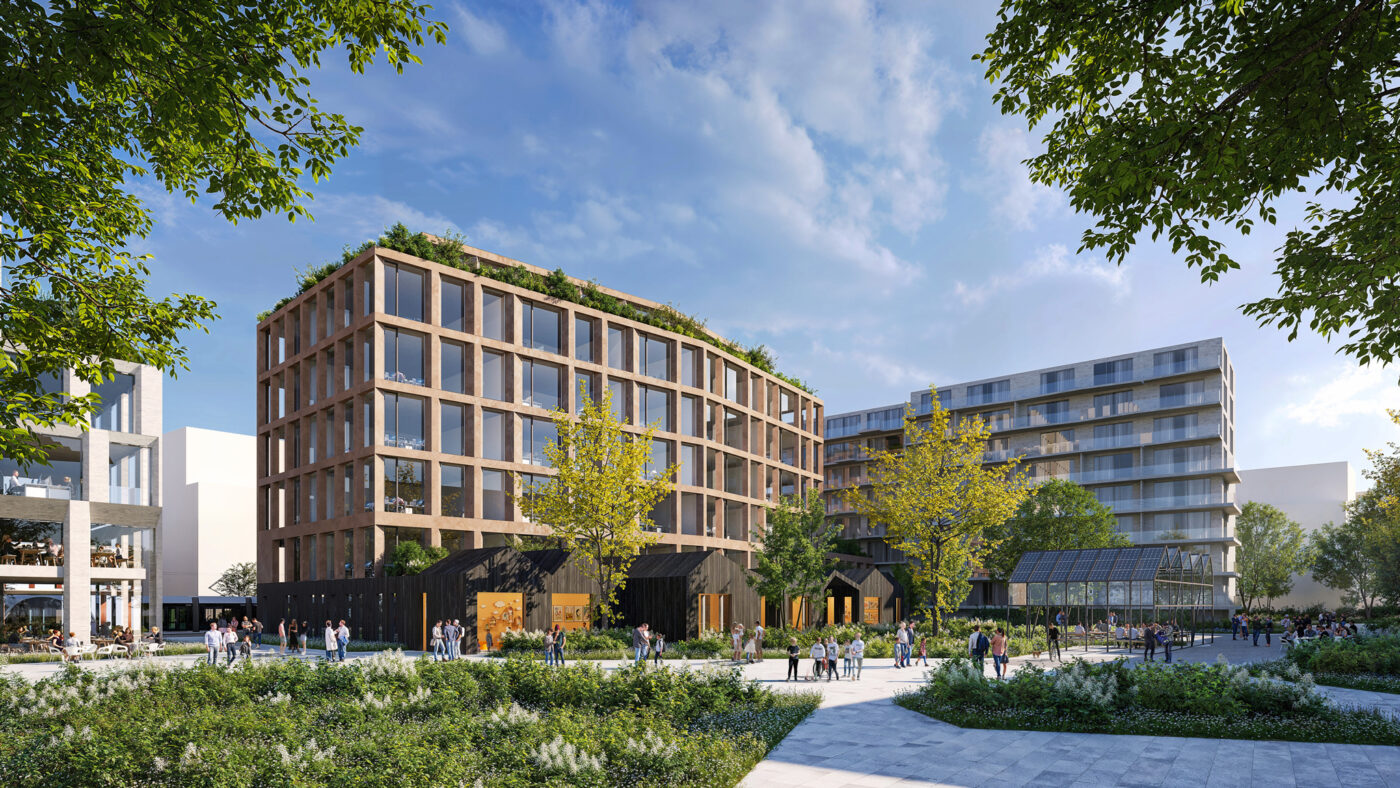
Landscaped spaces play a central role in the quality of life the project offers. The two inner courtyards provide complementary atmospheres: one calm and contemplative, dedicated to relaxation, yoga, and urban gardening; the other more active and family-oriented, incorporating play areas, a community greenhouse, and a crèche. Abundant vegetation, trees planted in open ground, and climate-adaptive landscaping reinforce the ecological character of the project.
The dwellings are designed to be flexible, light-filled, and suited to a variety of resident profiles. The project offers a rich typological diversity: dual-aspect apartments, duplexes, town houses, and adaptable units. All living spaces benefit from a favourable orientation towards green areas and sunlight. Universal accessibility and circulation routes for people with reduced mobility have been integrated from the outset.
From an environmental standpoint, the project rests on an ambitious energy strategy combining heat pumps, geothermal energy, passive cooling, and optimised rainwater management based on the “sponge city” principle. The buildings favour durable, bio-based, and reusable materials, with a hybrid construction approach combining timber, concrete, and steel according to technical requirements. Circularity and the potential for future transformation of the buildings are fundamental principles of the project.
Finally, the project aims to achieve long-term cost efficiency through rationalised construction solutions, durable materials, and standardised typologies. The mix of uses, proximity to public transport, and diversity of housing types enhance the economic and rental attractiveness of the neighbourhood, conceived as a forward-looking “fifteen-minute city” model.
- client
- Fonds de Compensation commun au régime de pension & Ville de Luxembourg
- competition
- Winning project for lots 3.1 and 3.2
- year
- 2024
- site area
- 8.600 m2
- address
- Hollerich, Luxembourg
- photos
- BFF... & Fabeckarchitectes